How to Tell If Your Idea Is Worth Anything
Most Ideas Are Bad.
Not because the people who have them are bad. But because ideas are easy to romanticise and hard to stress-test. We fall in love with them before we've even shown them daylight.
The good news: working out whether your idea has legs is not that complicated. It just requires you to do something most founders avoid. Talk to people honestly, listen carefully, and be willing to hear things you don't want to hear.
And in 2026, there is genuinely no excuse not to do this properly. The tools available to you today would have seemed like science fiction to founders five years ago. You have AI, no-code builders, prototype tools, and global communities at your fingertips. The bar has risen. The expectations have risen with it. That's what this guide is about.
The Post-AI Reality: You Have No Excuses
Let's get something out of the way before we talk about validation frameworks. We are living through the most founder-friendly moment in history. AI tools can help you research markets, write landing page copy, build no-code prototypes, generate customer survey questions, analyse competitor products, and even write the first draft of your pitch deck. Most of this is free or nearly free.
Which means one thing: the bar for what counts as 'validated' has risen significantly. And so has investor expectations to match.
What This Means Practically
If you are building in software, SaaS, apps, or anything digital, you genuinely cannot walk into a serious investor conversation or an accelerator application without having already:
Talked to at least 20 real potential customers about the problem (not just the idea)
Built something, even if it is a no-code prototype, a Figma mockup, or a landing page that collects signups
Attempted to get paying customers. Even one paying customer changes everything.
Generated some kind of signal: waitlist, pilot agreement, letter of intent, pre-order, or revenue
In the early stage investor landscape right now, money is harder to raise. The volume of investors, particularly early stage angels, has shrunk relative to the number of startups seeking funding. The cream rises to the top. To be in that top tier, you need to show up exceptional.
The founders who are winning raises in 2026 are not the ones with the best ideas. They are the ones with the best evidence. Real conversations. Real signals. Real customers.
The Tools That Make This Possible
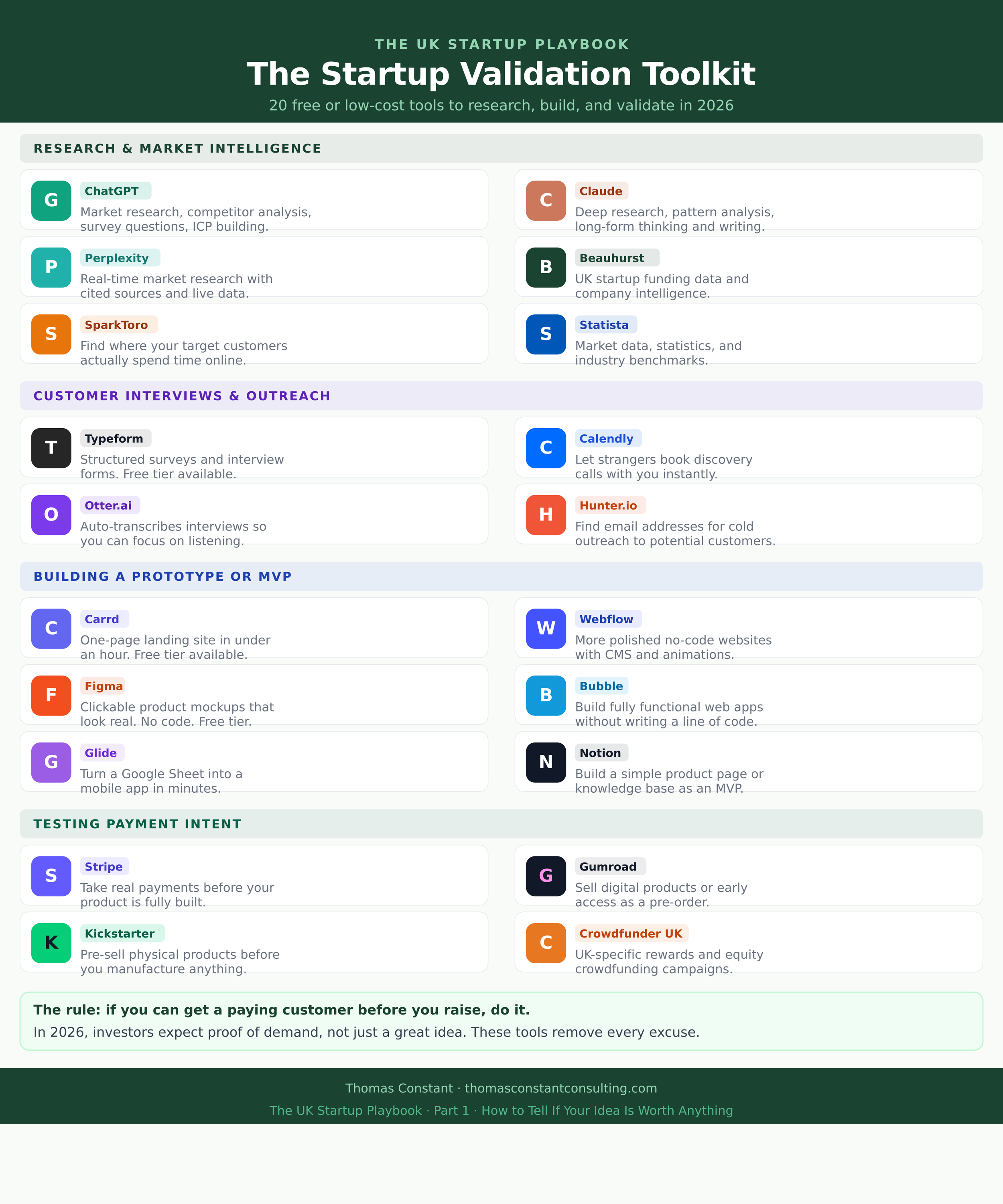
The point: you can now research, prototype, validate, and collect payment for an idea in a single weekend. If you have been sitting on an idea for months without doing any of this, the problem is not resources. It is resistance. And investors can tell.
1. Stop ‘Hoarding’ Your Idea
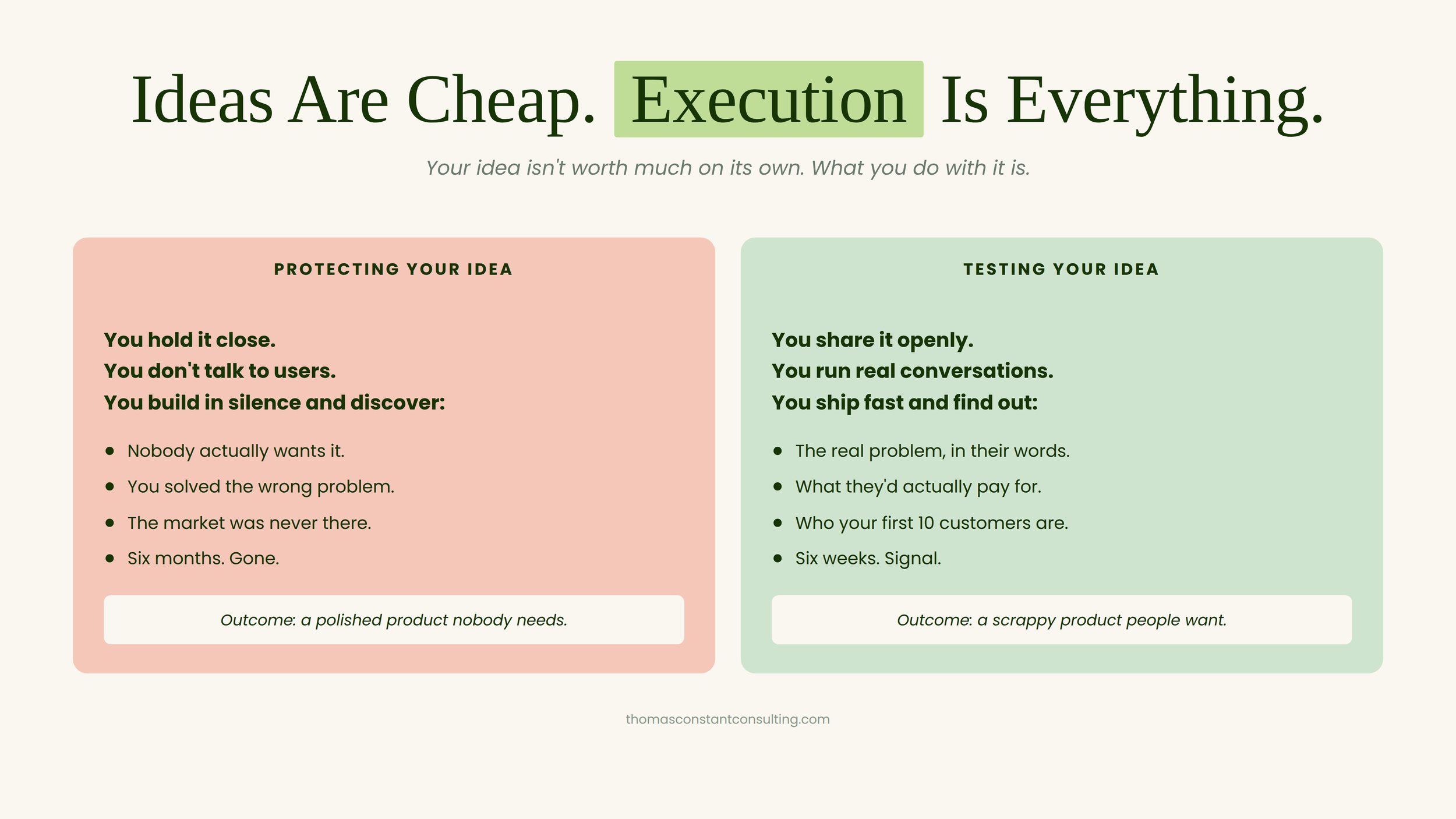
There is a very British thing that happens with startup ideas. People hold them close to their chest, terrified someone will steal them. I see it constantly. Here is the reality: if your idea is so easy to steal that mentioning it to another human being puts it at risk, it is probably not defensible anyway. What builds a startup is not the idea. It is execution, speed, customer insight, and adaptability.
The person who hears your idea and then goes off to build it themselves would also have to quit their job, find co-founders, raise money, build the product, get customers, and be better at it than you. The risk is almost always zero. What has a real cost is not sharing the idea. Because the feedback you get from talking about it is more valuable than any protection you gain from silence.
2. Validate First. Build Later.
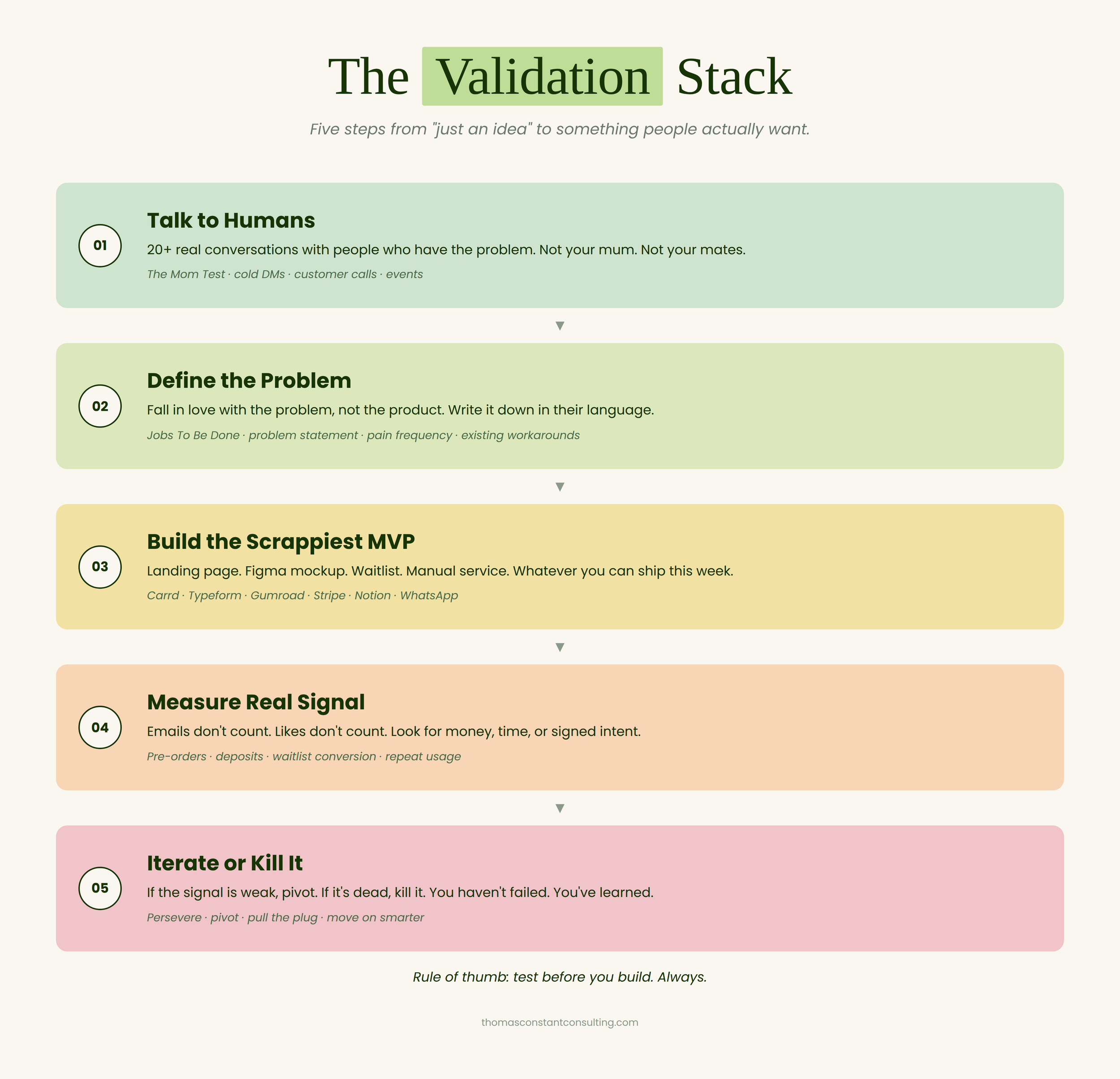
First-time founders have a habit of building before they have talked to anyone. They spend months perfecting a product, then ask people what they think. That is completely backwards. Real validation means uncomfortable conversations with real strangers about a real problem. Not your mate saying it sounds cool. Not your mum saying she would definitely buy one. Those people love you. They are not your market research.
The Mom Test: the one book you must read
Rob Fitzpatrick wrote a short, brilliant book called The Mom Test. The entire premise: if you ask your mum whether your business idea is good, she will say yes. Not because it is, but because she loves you. Stop asking about your idea, and start asking about their life.
Bad question: "Would you use an app that helps you track your food waste?" It is hypothetical. People answer the way they think you want them to.
Good question: "Tell me about the last time you threw away food you had bought. What happened?" It is about their actual behaviour, not a hypothetical future one.
A few core principles from the book:
Ask about the past, not the future. "Have you ever..." beats "Would you ever..." every single time
Ask about behaviour, not opinions. What people do tells you more than what they say they would do
Watch for commitment signals. Have they tried to solve this before? Have they spent money on it?
Dig into specifics. "How do you currently deal with that?" is gold
3. Fall in Love With the Problem, Not Your Product
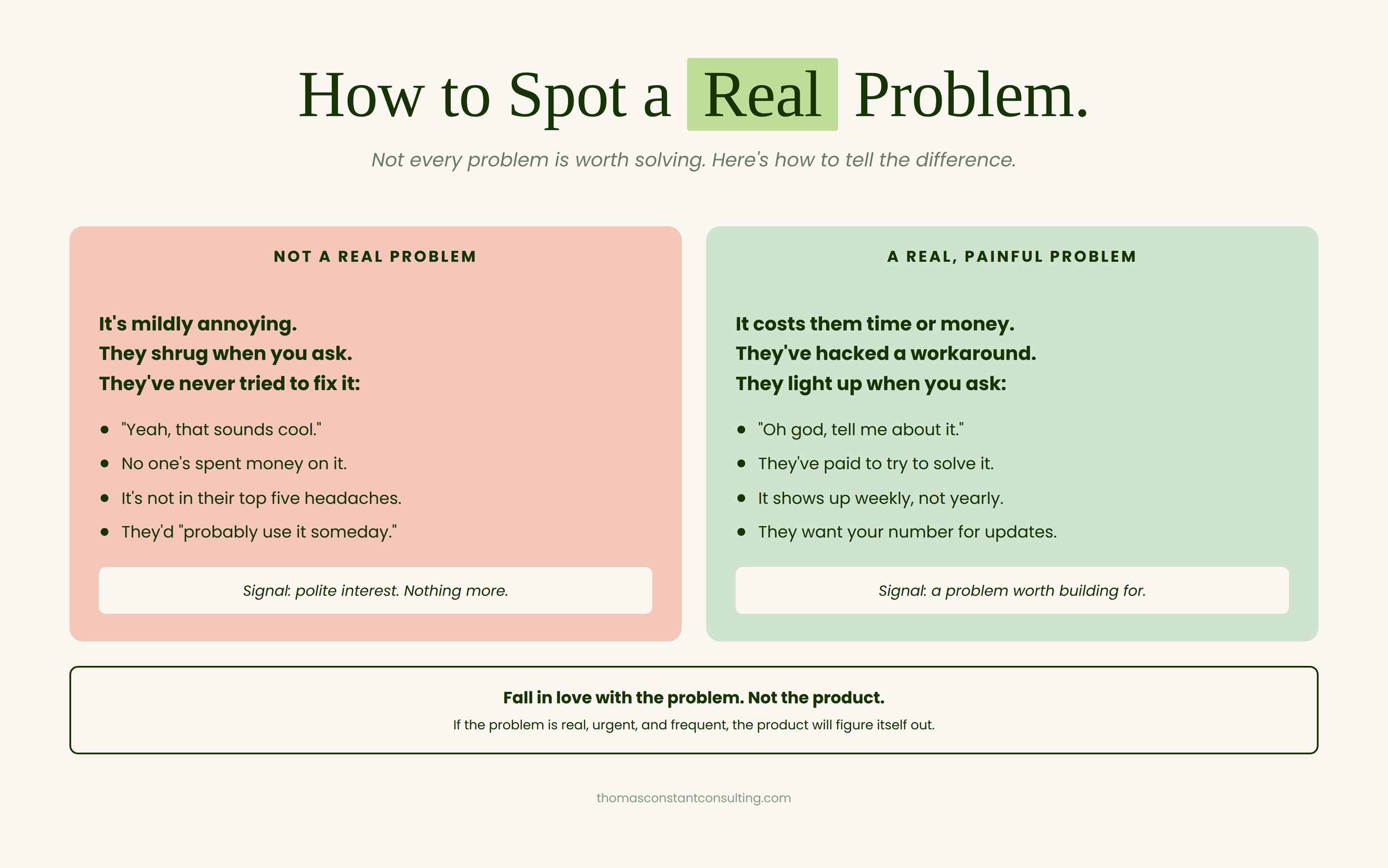
This is where most founders go wrong. They get attached to their solution before they have properly understood the problem. Start with the problem. Go deep on it. Understand exactly how it shows up in your target customer's life, how often, how much it costs them, and what they are doing about it today.
Questions that actually uncover whether a problem is worth solving:
How are you solving this right now?
What is frustrating about that approach?
Have you paid for something to fix this before? What happened?
How much does this problem cost you in time, money, or stress?
If this problem disappeared tomorrow, what would that be worth to you?
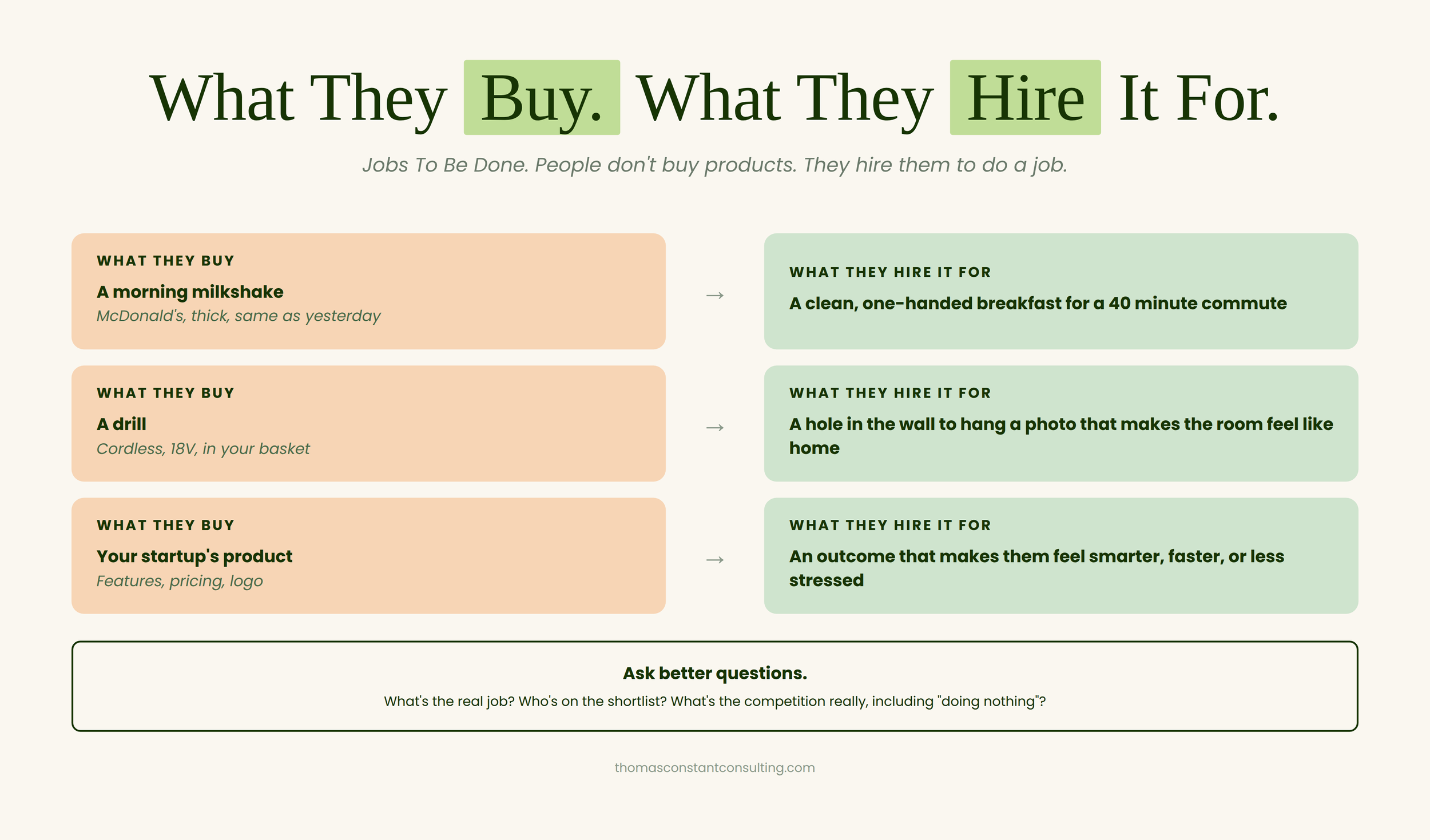
Clayton Christensen's Jobs To Be Done framework is worth understanding here. People do not buy products. They hire them to get a job done in their life. Once you understand the real job, your messaging, your MVP, and your sales pitch all become much clearer.
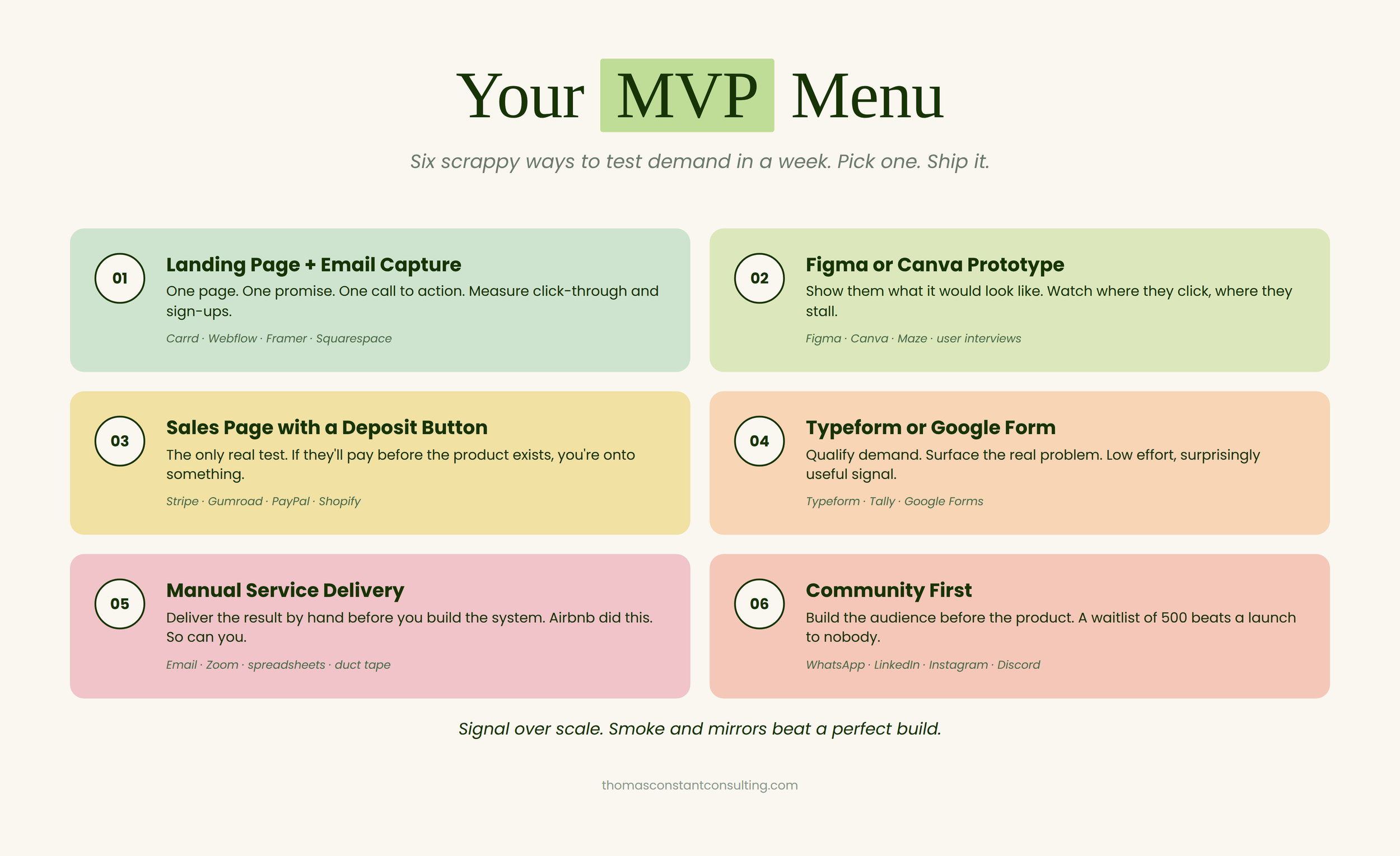
4. Build the Smallest Possible Thing to Test Demand
Your MVP is not your product. It is a question with a physical form. The question: does anyone care enough to engage, sign up, or pay? Everything else is a guess until you answer that.
Landing page:Carrd or Webflow. Done in a day. Tests whether people are curious enough to give you their email.
Prototype:Figma mockup. Looks real. Costs nothing. Tests whether the concept makes intuitive sense.
Payment button:Stripe link or Gumroad. The ultimate test. Will someone pay before it fully exists?
No-code app:Bubble or Glide. A working functional product without writing code. Real usage data, not just intent signals.
Manual delivery: Do the thing by hand first. Airbnb did this. Nobody knew. It proved the demand was real.
With Bubble, Glide, or Softr, a non-technical founder can have a working functional product ready in a weekend. With Stripe, they can take payments from day one. There is no longer a meaningful technical barrier to getting your first paying customer before you raise a penny. Investors know this. They will ask why you have not done it.
5. How to Structure Your Customer Discovery
Step 1: Define your assumed customer specifically. Not "small business owners" but "solo freelance designers in the UK who invoice more than five clients a month." Use Claude or ChatGPT to help you build a detailed ICP based on the problem you are solving.
Step 2: Get the conversations. Aim for at least 20 before drawing conclusions. Find people through LinkedIn, relevant Reddit threads, Slack and Discord communities, and cold email using Hunter.io to find addresses. Keep the message under 60 words and ask only for 20 minutes.
Step 3: Run the conversations well. In person conversation or video calls. Use Otter.ai to transcribe automatically. Start by asking about their current situation, not your idea. After each call, write down the three most important things you heard.
Step 4: Look for patterns. After 10 to 15 conversations, the same frustrations will emerge. If 8 out of 10 people mention the same pain point unprompted, that is a real problem worth solving. Paste your notes into Claude or ChatGPT and ask it to identify the strongest signals.
Step 5: Test purchase intent before you build. Set up a landing page, add a payment link, drive 100 people who you think might be customers to it. If 3 to 5% convert, you have a signal worth acting on.
6. Your First Idea Will Change. That Is Fine.
The version of your idea you have today is not the version you will build. That is not failure. That is how it works. Slack started as an internal tool for a gaming company. Instagram started as a check-in app. YouTube started as a video dating site. The founders did not fail. They listened, adapted, and found what was actually working.
Read The Lean Startup by Eric Ries for the framework on how to structure your learning so that when your idea needs to change, you change it fast and in the right direction.
7. Maybe Don't Quit Your Job. Not Yet.
The "quit everything and follow your dream" narrative is great content. It is terrible advice for most people at the validation stage. Unless you have six months of personal runway, revenue already coming in, or someone else's money in the bank, keep the income. Build in the mornings. Build in the evenings. Let the idea earn its place before it takes over your life.
When to actually make the leap:
You have paying customers and the revenue is growing
You have raised at least a small amount of external capital
The opportunity cost of staying employed is actively hurting the business
You have enough personal runway to cover 12 months without income
The validation is strong enough that staying feels like the real risk
TL:RD - The Short Version
The bar has risen. "I have a great idea" is not enough in 2026. You need evidence.
Use the tools available. AI and no-code mean there is no resource barrier to validation anymore.
Share the idea. The feedback is more valuable than the secrecy.
Talk to real people about the problem, not your idea. Past behaviour over future hypotheticals.
Build the smallest possible thing to test whether people actually care.
Aim for 20 customer discovery conversations before drawing conclusions.
Your first idea will evolve. Let it.
Keep your job until the signal is genuinely strong.
Validation is uncomfortable. It is also the only way to know you are not wasting your time. And in 2026, it is faster, cheaper, and more achievable than it has ever been.
Start there.
———————————
———————————
Reading List and Resources
The Mom Test by Rob Fitzpatrick — The gold standard on how to talk to customers without getting biased answers. Read this before you speak to a single potential customer. momtestbook.com
Atomic Habits by James Clear — Most founders obsess over big moves. This book shows why the small daily ones matter more. You fall to the level of your systems, not your goals.
The Hard Thing About Hard Things by Ben Horowitz — Nobody tells you what leadership actually feels like when things go wrong. Ben Horowitz does. Brutally honest and essential reading.
The Lean Startup by Eric Ries — The OG framework for building, testing, and learning fast. Read it early, before you've wasted six months building something nobody wants. theleanstartup.com
The 4-Hour Workweek by Tim Ferriss — Forces you to question whether how you work actually makes sense. If the business only works when you're there, it is not a business.
Deep Work by Cal Newport — Your most valuable resource as a founder is focused thinking time. This book will make you protect it.
Start With Why by Simon Sinek — Mission-driven companies attract better customers and better teams. If you cannot answer why you are building this, read this first.
Key Person of Influence by Daniel Priestley — Authority in a specific niche compounds over time. Being known for one thing is more powerful than being good at many.
Zero to One by Peter Thiel — Challenges you to think about whether you are actually doing anything different. The strongest businesses stop competing and design a category they can own.
Blue Ocean Strategy by W. Chan Kim and Renée Mauborgne — If you feel stuck competing on the same metrics as everyone else, this will reframe how you think about growth entirely.

Want Help Applying This to Your Startup?
♻️ Book a free 30-minute Investment Readiness Clarity Call. No pitch required. Just an honest conversation about where you are and what to focus on next.
🔔 Book your free call at thomasconstantconsulting.com